


I'm looking for information about
Can't find what you're looking for? You may need to login to see more documents
G
Guidelines
Suggested parameters and sets of instructions outlining best practices and standards for accomplishing specific animal care and use research duties.
Suggested parameters and sets of instructions outlining best practices and standards for accomplishing specific animal care and use research duties.
This Copy Was Generated On: September 29, 2026
Guidelines on Medical Records for Investigative Personnel
Unit for Laboratory Animal Medicine
| Approval Date:
October 17, 2025 12:00 am
To define the components of a medical record that are the responsibility of the investigative personnel, and to describe the procedures for generating, maintaining, and storing them.
Responsibility
- ULAM Husbandry personnel
- ULAM Veterinary personnel
- Investigative personnel
Glossary Definitions
Types and Components of Records:
Permanent Medical Record
A file identified by an animal’s clinical number that contains all health, surgical, and/or procedural records generated for an animal. This includes, but is not limited to, Animal Treatment Reports, surgical and post-operative records, diagnostic test results, radiographs, USDA number, etc.
Health/Group Health Record
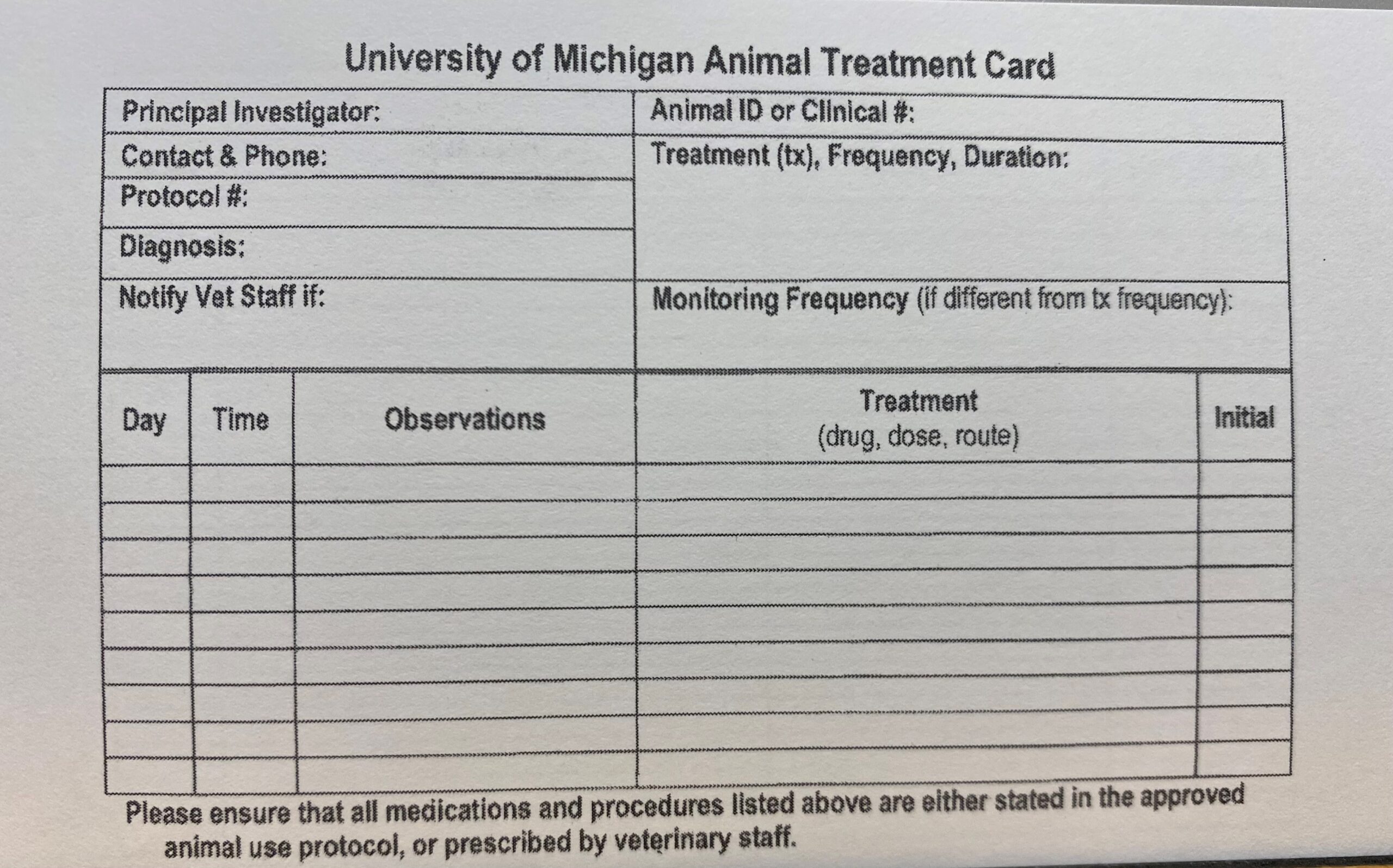
A record maintained by veterinary or investigative personnel detailing the care and management (treatments, monitoring, etc.) of a health condition that is performed by the investigative personnel under the direction of the ULAM veterinary personnel. For clinical treatments, in most situations, ULAM will provide a Treatment Card to act as the record.
Post-Operative Record
A record maintained by veterinary or investigative personnel to detail the post-operative monitoring period.
Food and/or Water Restriction Records
A record maintained by investigative personnel that details deviations in the provision of food and/or water.
Surgical/Anesthetic/Sedation Record
A record maintained by veterinary or investigative personnel detailing any surgical/anesthetic/sedation procedures.
Experimentally Induced Disease/Research Record
A record that may be maintained by investigative personnel and may include details such as animal identification information, procedures performed, observations, etc.
Breeding Record
A cage specific record that may include details such as breeder information, mating information, litter information, etc.
Record of Disposition
A record of the death, euthanasia, transfer, sale, adoption, or donation of an animal.
Records from Vendor
Health information/medical history that arrives with the animal and is incorporated into the animal’s permanent medical record.
Clinical Number
A unique identifying number assigned by the ULAM personnel used to centralize information into complete medical records in a retrievable form. Clinical numbers may be assigned to an individual animal or a group of animals depending on the species/circumstance. The format is CLN########.
Active Case
Cases involving animals currently being treated and/or monitored for a clinical or experimental condition (e.g., tumor burden, food and/or water restriction, etc.).
Inactive Case
Cases involving animals that are no longer being treated and/or monitored. Cases become inactive when a clinical condition is resolved by the veterinary personnel or when the animal is euthanized, un-enrolled from the study, or transferred to another institution/laboratory.
Procedures
1. Generating and Maintaining Records
- Required Records for Investigative Personnel to Generate and Maintain:
- Health/group records (including Treatment Cards) if investigative personnel are performing any part of the monitoring and care of a non-research-related clinical condition under the direction of the veterinary personnel.
- Surgical/anesthetic/sedation for animals undergoing such procedures.
- See Anesthesia and Sedation Monitoring Guidelines.
- See Guidelines on the Performance of Surgery in Non-Rodent Mammals.
- See Guidelines on the Performance of Surgery in Rodents.
- See this tool to verify exactly which records you need to keep.
- Post-operative monitoring records for animals undergoing survival surgery.
- See Guidelines on the Performance of Surgery in Non-Rodent Mammals.
- See Guidelines on the Performance of Surgery in Rodents.
- Tumor monitoring records as described in the IACUC-approved animal care and use protocol for animals with experimentally induced tumors.
- Food and water restriction records for animals undergoing such restrictions as described in the IACUC-approved animal care and use protocol.
- Disposition records for cats and dogs.
- Recommended Records for Investigative Personnel to Generate and Maintain:
- Experimentally induced disease/research records.
- Breeding records.
- Consider digital records to track breeding colony success over time using excel or an online mouse colony tracking software.
- ULAM provides the following forms for use by investigative personnel:
- See Appendices A and B for Rodent Surgery and Post-Operative Records (“Notebook” and ”By Cage” versions).
- See Appendix C for an example on how to fill out a “Notebook” version record.
- Pre-printed cage card-sized templates are available from ULAM on request
- See Appendix D for the Non-rodent Mammal Intra-Operative Monitoring Form.
- See Appendix E for the Non-Rodent Post-Operative Medical Record Form.
- See Appendix F for the Treatment Card.
- See 2.b.iv and Appendix G for information on the disposition of Dogs/Cats by death, euthanasia, sale, transfer, donation or adoption.
- See Appendices A and B for Rodent Surgery and Post-Operative Records (“Notebook” and ”By Cage” versions).
- Investigative personnel may create different record templates to fit the preferences and needs of the research.
- Ensure the records contain the same information as described in the ULAM templates.
- Include the following information when making an entry into any type of record:
- Date and initial all entries.
- Write legibly.
- Write drug names in full, e.g., buprenorphine, not “bup”..
2. Storing and Submitting Records
- Active cases
- Health/group health records: Maintain in the animal room until the case is resolved by the veterinary personnel or the animal is euthanized.
- Ensure records can be made available within four working hours on request of the veterinary personnel, or institutional or regulatory inspectors e.g., (IACUC, AAALAC, etc.).
- Treatment Cards: Maintain in the animal room for the duration of the treatment. Veterinary personnel collect when the treatment is complete
- Surgical/anesthetic/sedation record and post-operative records: Maintain in the animal room for the post-operative period as defined by the surgical guidelines.
- Ensure records can be made available within four working hours on request of the veterinary personnel, or institutional or regulatory inspectors e.g., IACUC, AAALAC, etc.
- Food and water restriction records: Maintain in close proximity to the animal (in the animal room is preferred) for the duration of restriction.
- Health/group health records: Maintain in the animal room until the case is resolved by the veterinary personnel or the animal is euthanized.
- Inactive Case
- The following documents are required to be submitted to ULAM as described below. All other documents can be maintained in the lab and must be available for review within 4 hours of request by veterinary or regulatory personnel (e.g. IACUC, AAALAC).
- Rodents and non-mammals: Surgical and post-operative records for survival surgeries
- Non-rodent mammals: Treatment cards, surgical and post-operative records (including anesthetic monitoring for all surgeries, whether survival or terminal), disposition records for dogs and cats
- Non-USDA-regulated species
- Investigative personnel place records (or copies of records) within one week of final record entry into the drop box in the animal housing rooms for animals not covered by the Animal Welfare Act including:
- Mice (genus Mus)
- Rats (genus Rattus)
- Fish
- Reptiles
- Amphibians
- Captive-bred birds
- Husbandry personnel collect the records once per calendar month and turn into the ULAM husbandry supervisor.
- Husbandry supervisor submits to the ULAM business office for veterinary review and storage.
- Investigative personnel place records (or copies of records) within one week of final record entry into the drop box in the animal housing rooms for animals not covered by the Animal Welfare Act including:
- USDA-regulated species
- Investigative personnel submit records (or copies of records) within one week of the final entry in the record to ULAM for all animals covered by the Animal Welfare Act.
- ULAM stores the records long-term according to the Procedures for Veterinary Medical Records
- Examples of final entries are:
- Euthanasia
- The end of post-surgical monitoring
- The resolution of a clinical case
- The transfer to another institution or laboratory
- Confirm the records contain the following information before submitting to ULAM (documents without the required information are not accepted):
- Protocol number
- Principal investigator last name
- Animal’s clinical number (if one has been assigned by ULAM personnel)
- Place completed records in the ATR /Records drop-boxes. These boxes are located:
- Outside the veterinary technicians’ offices in MSII, BSRB, CH, Brehm, and NCRC.
- Outside break rooms in MSRB and BSRB.
- Contact the husbandry supervisor in your area for ATR drop-box locations in other buildings.
- It may be acceptable to submit documents to the ULAM veterinary team electronically if discussed and approved by the faculty veterinarian for the area.
- Investigative personnel submit records (or copies of records) within one week of the final entry in the record to ULAM for all animals covered by the Animal Welfare Act.
- Disposition of dogs and cats:
- Generate Records of disposition for all dogs and cats using USDA APHIS Form 7006 (see Appendix G) and include:
- USDA identification number.
- Description of animal (species, breed, markings, sex, age).
- Date and manner of disposition (euthanasia, transfer, etc.).
- Investigative personnel turn in the disposition records to the veterinary technicians.
- The veterinary technicians store as part of the animal’s medical record according to the Procedures for Veterinary Medical Records.
- Promptly return USDA-numbered collars/tags from euthanized dogs and cats to the ULAM Husbandry Supervisors.
- Generate Records of disposition for all dogs and cats using USDA APHIS Form 7006 (see Appendix G) and include:
- The following documents are required to be submitted to ULAM as described below. All other documents can be maintained in the lab and must be available for review within 4 hours of request by veterinary or regulatory personnel (e.g. IACUC, AAALAC).
Appendices
Appendix A: Rodent Surgery and Post-Operative Record (Notebook Size)
Appendix B: Rodent Surgery and Post-Operative Record by Cage
Appendix C: Examples of Rodent Surgery and Post-Operative Records
Appendix D: Non-Rodent Mammal Intra-Operative Monitoring Form
Appendix E: Non-Rodent Mammal Post-Operative Record Form
Appendix F: Treatment Card
Appendix G: USDA APHIS Form 7006
References
- Field K, Bailey M, Foresman LL, et al. (ACLAM Medical Records Committee). Medical records for animals used in research, teaching, and testing: public statement from the American College of Laboratory Animal Medicine. ILAR J. 2007;48(1):37-41.
Questions?
Questions or concerns about the content of this document should be directed to the Unit for Laboratory Animal Medicine (ULAM) at (734) 764-0277 or [email protected].